Inside 'The Line': Saudi Arabia's Linear City, from a 170-km Plan to a 2.4-km First Phase
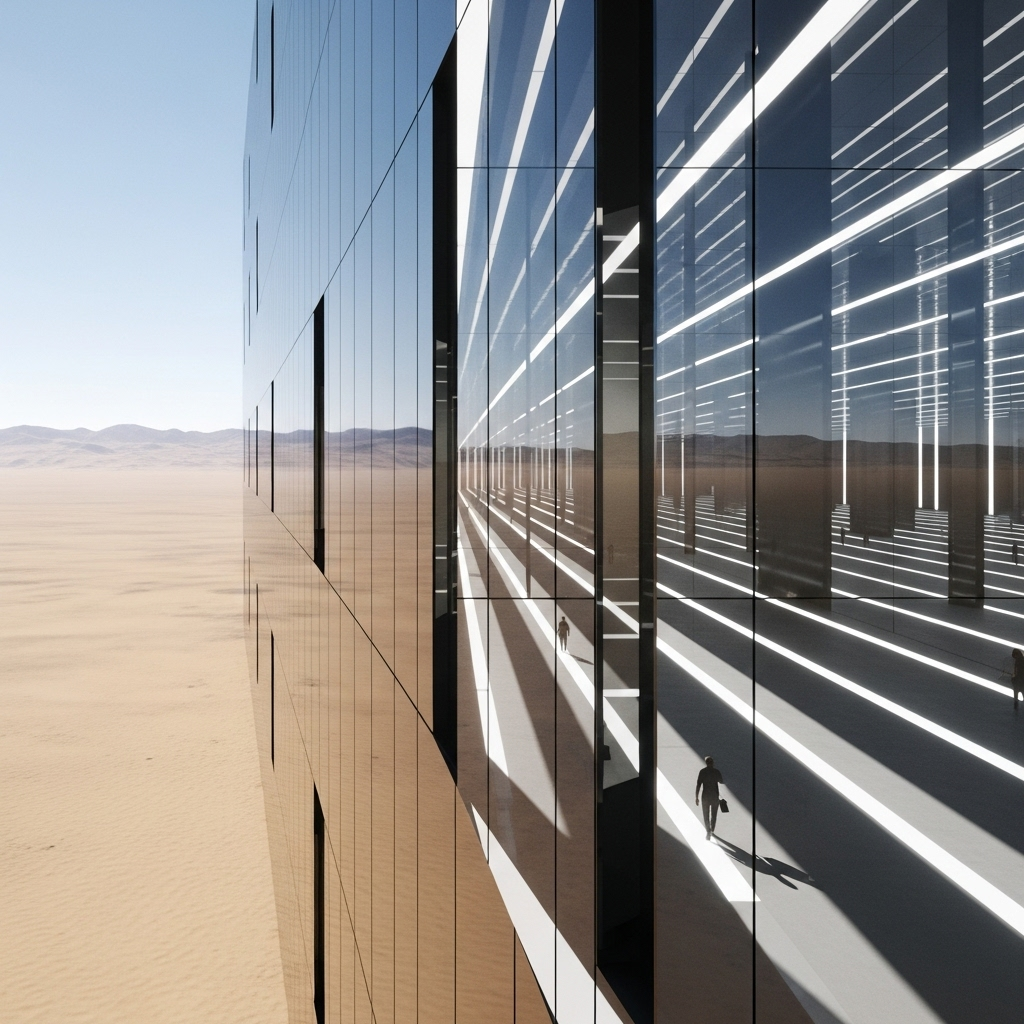 The Line is the centrepiece of Neom, the development region Saudi Arabia is building in its north-western desert: a mirrored structure presented in 2022 as 170 kilometres long, 200 metres wide and 500 metres high, designed to house nine million people without cars or roads, powered by renewables, with an official cost estimate of around $500 billion. This post summarises an architectural analysis of that design by Daniel Titchener (August 2025) and sets it against the reporting on what has actually been built and paid for since.
The design that was announced
The published plans describe two parallel towers forming a continuous wall, with the horizontal transport running inside rather than on the surface. Neom's own framing was that the layout would replace the outward growth of conventional cities with a structure the length of a country, and that residents would reach services within a short walk. The design drawings also include elements that the reporting has since questioned, such as a marina, a stadium above it and a building suspended upside down from an arch.
The architectural argument in the video
Titchener's analysis works through three themes, each of which is his reading of the design rather than a finding about the construction site:
- Sprawl, inverted. Where conventional cities expand outward, The Line constrains everything along one axis. Titchener's point is that this trades one constraint for another: internal high-speed transit has to carry all movement, and the enclosure leaves little room for the incremental expansion and change that cities normally absorb.
- Liveability. The video questions how daily life works inside a wall: daylight and ventilation for residents who are not on an outer face, and the loss of the varied street-level surroundings that ordinary cities provide. It notes that the proposed compensations — vertical farming, integrated services — are plans rather than demonstrated practice.
- Perfection. The structure is engineered from a fixed specification in one direction. Titchener argues that this leaves little space for the adaptations that cities acquire over decades, and that the rigidity is a design risk in its own right.
Those are architectural objections. The reporting below is about money and schedule.
What the reporting shows
- The Financial Times traced The Line through interviews with more than twenty people who worked on it (architects, engineers, former senior executives), published on 6 November 2025. Its findings: at least $50 billion has been spent, the desert is marked by piling and deep trenches, and the first phase has been scaled back sharply. Internal estimates of the budget moved from $1.6 trillion in late 2021 to around $4.5 trillion in the spring of 2022, according to the same reporting.
- The Wall Street Journal reported that the first phase is now planned at roughly 1.5 miles (2.4 kilometres) of structure by 2030, instead of the approximately 10 miles previously envisioned, that internal expectations for the first phase run below 200,000 residents, and that a draft board presentation put the capital needed to build out Neom to its end state by 2080 at $8.8 trillion.
- CNBC reported in July 2025 that the Public Investment Fund, which finances Neom, had engaged consulting firms for a strategic review of The Line's feasibility; Neom confirmed the review and described such checks as common practice on long-term projects.
What Neom says
Neom told the Financial Times that The Line remains "a strategic priority", that it would ultimately "provide a new blueprint for humanity by changing the way people live", and that it is a "multi-generational development of unprecedented scale and complexity". The company says attention has moved to "the complex engineering and detailed design work associated with the first phase". Asked about the scaled-back first phase, Saudi minister of economy and planning Faisal Al Ibrahim said in a CNBC interview that "there is no change in scale — it is a long-term project that is modular in design", adding that the kingdom does not want to overheat its economy. Neom's deputy chief executive Rayan Fayez said the project's budget "evolves every day".
What is not settled
No cancellation of The Line has been announced, and Neom has not published a revised master plan, budget or timeline, so the figures above come from internal documents and people involved rather than from official releases. The step that would make the project hard to reverse — awarding the contracts for the construction above ground — had not been taken, according to the Financial Times. Whether a shortened first phase is a staging post or the practical end of the 170-kilometre plan is therefore still open, as is the question of what happens to the completed groundwork if the vertical building does not follow.
Original video: https://youtu.be/c-jtIRvmbsk
Sources
- Daniel Titchener: Life Inside "THE LINE" — Why Saudi Arabia's Glass Megacity Will Fail (YouTube, August 2025)
- Financial Times: End of The Line — how Saudi Arabia's Neom dream unravelled (6 November 2025)
- Wall Street Journal: Why the World's Largest Megaproject Collapsed — video report on the investigation (the written article is behind a paywall)
- CNBC: Saudi Arabia's 'The Line' at Neom is reviewed as it considers its megaprojects (18 July 2025)
- Neom (official project site)