It's Happening: Europe Is Building an Impossible Fusion Reactor
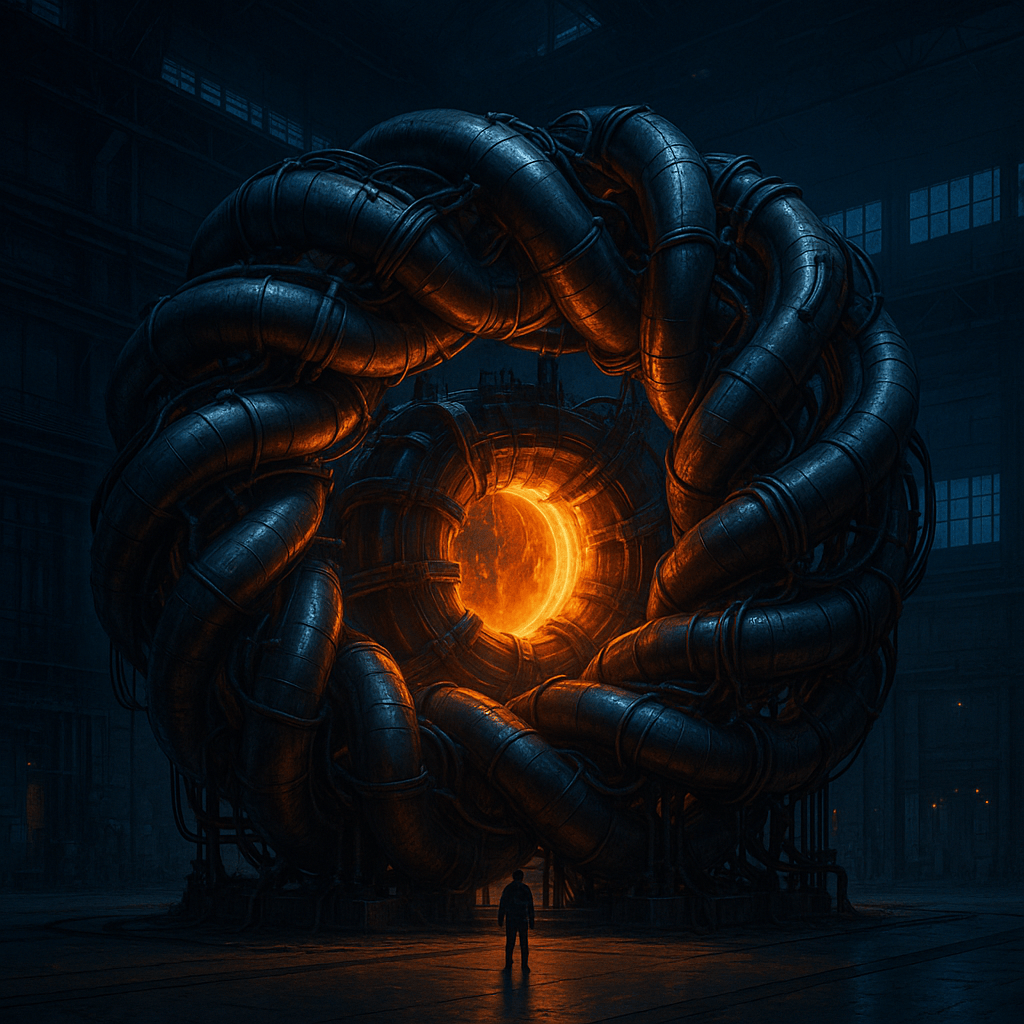
Proxima Fusion has €411 million to build the shape the fusion world walked away from. The Munich startup, spun out of the Max Planck Institute, counts Google and energy giant RWE among its backers. Its reactor is a stellarator: a twisted "donut" so absurdly complicated it was long believed impossible to build.
For fifty years the tokamak has dominated fusion research. The classic donut-shaped reactor is the design that gets the money. Proxima is betting everything on the other one, and on a plan to build the first stellarator power plant in history. The money is already committed. The cage is not built, and that gap decides whether fusion ever reaches a grid. Everyone who pays an electricity bill is downstream of that question.
A Cage That Leaks
Fusion means slamming atomic nuclei together until they merge. That takes 100–150 million degrees Celsius, and no material can touch it. So the plasma has to hang suspended in a magnetic cage. There is nothing to catch it. The magnets are the only thing between that heat and the wall of the vessel.
The simplest cage is a donut-shaped torus, and it leaks. The field is stronger on the inside of the ring. Ions and electrons drift apart until the plasma pushes itself into the walls. Nothing in the machine survives contact with the plasma. The field is the wall, and it is only as good as its twist.
The fix is a helical twist in the field lines. The stellarator is the shape that provides that twist on its own. Every machine in this story is an argument about how to get it.
The Design the World Walked Away From
The tokamak gets its twist by running a current through the plasma itself. That made it easy to build, and in 1968 the Soviet T-3 convinced the world to abandon stellarators almost overnight.
What the world took on instead comes with a timer. A transformer only works while the current is changing, so every tokamak runs in pulses. ITER, the largest fusion project on Earth, aims for burns of about 400 seconds before it needs a timeout. Fine for science, fatal for a power plant. Anyone waiting on fusion electricity is waiting on a machine that runs for hours, not for 400-second bursts.
Not everyone left. A small group at the Max Planck Institute kept working on the stellarator, and their Wendelstein 7-X finally proved the physics of the absurd shape. In 2023 it held a 40-million-degree plasma for eight full minutes. But W7-X can never produce more energy than it consumes. It is a physics experiment, and the gap to a power station is the whole problem.
The tokamak won the money. The stellarator won the physics.
Proxima's Cheat Code: Stronger Magnets
Proxima's bet is that fusion power scales with the fourth power of the magnetic field. Double the field, and the power goes up 16 times.
W7-X's niobium-titanium magnets quit past 12 tesla, so Proxima uses REBCO, a high-temperature superconducting tape pioneered by MIT and Commonwealth Fusion Systems. Its design runs at around 9 tesla on-axis, against W7-X's 2–3: roughly 81 times the potential output.
The roadmap: a full-scale test coil in 2027, a demonstration reactor called Alpha targeting net energy gain in the early 2030s, and 50 power plants by 2050. Industrial heat and the neutrons for medical isotopes are the returns along the way. The grid is the prize.
That is what the €411 million is buying. If the tape holds, the stellarator comes back. If it does not, the shape the world walked away from stays gone.
A Coil He Could Not Film
The video goes deep into the physics, and into a winding technique so proprietary the host was not allowed to film it. Well worth watching in full.
Sources
- Original video: It's Happening - Europe is Building an Impossible Fusion Reactor (Dr Ben Miles)
- Proxima Fusion