What Big Tech, Pharma and Food Companies Pay Where They Sell
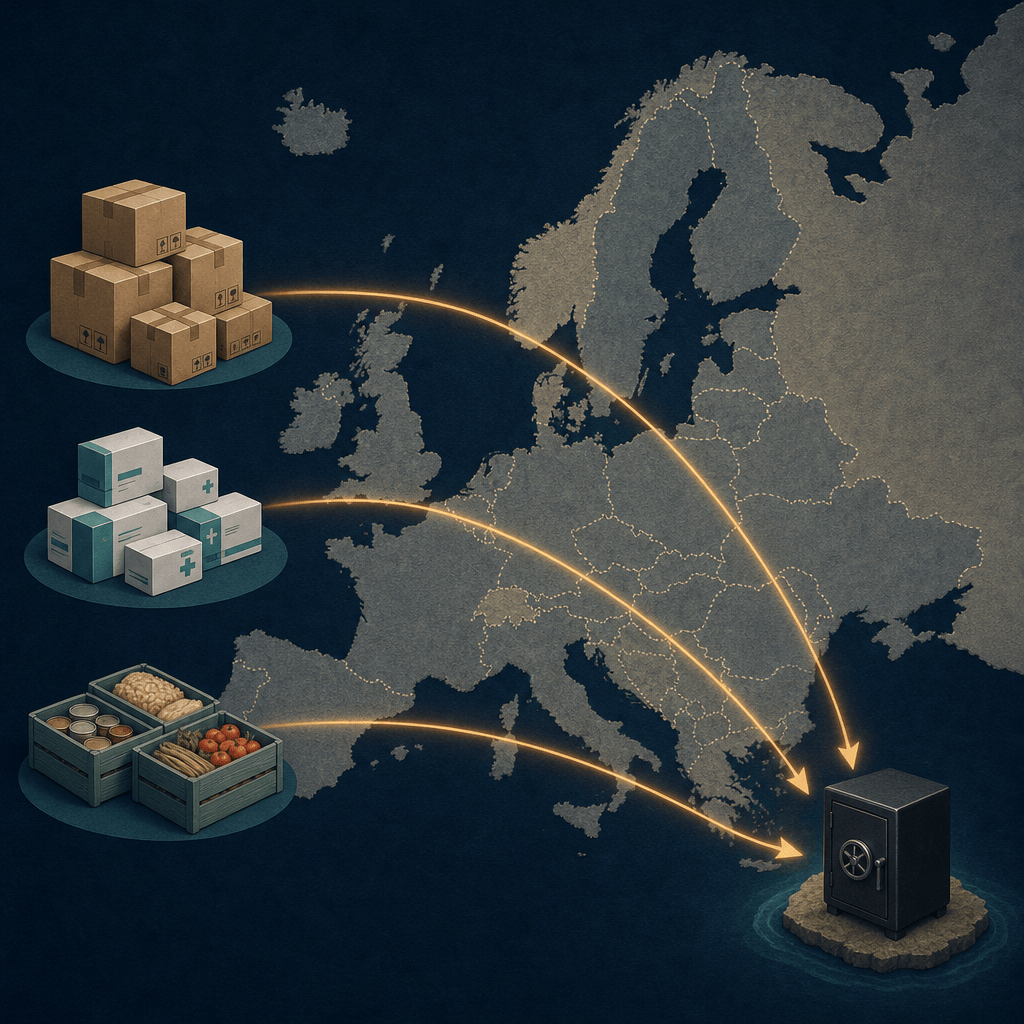
In a clip from the VPRO programme Tegenlicht, economist Yanis Varoufakis describes what he calls technofeudalism and makes a specific claim about Amazon: the company booked around 54 to 55 billion euros in European revenue and, in his words, paid exactly zero tax on it. He then argues that money which never enters a national treasury also never returns to households, and that European demand collapses by 30 to 40 percent as a result.
The first part of that claim is testable. The second is an argument. This post checks both against court rulings, company filings and the first public country-by-country reports that European multinationals had to publish this year.
Where the profit is booked, not where the goods are sold
In 2011, Apple's subsidiary Apple Sales International recorded 22 billion dollars of profit. Under the tax rulings it operated on, roughly 50 million euros of that was considered taxable in Ireland, leaving 15.95 billion euros untaxed. The company paid less than 10 million euros in Irish corporate tax that year, an effective rate of about 0.05 percent on its total annual profit. By 2014 that rate had fallen to 0.005 percent, according to the European Commission.
The Commission's conclusion in August 2016 went further than one company's rate: "the tax treatment in Ireland enabled Apple to avoid taxation on almost all profits generated by sales of Apple products in the entire EU Single Market." Ireland, it said, had granted undue tax benefits of up to 13 billion euros, and had to recover them.
That decision took eight years to become final. The General Court annulled it in July 2020 because the Commission had not proven a selective advantage to the required legal standard. On 10 September 2024 the Court of Justice set that judgment aside and confirmed the 2016 decision. Commissioner Vestager called it "a big win for European citizens and for tax justice", adding that the judgment was final.
The effects are visible in the new filings. Apple's public country-by-country report for fiscal 2025 lists, for Ireland alone, revenue of 213.6 billion dollars, pre-tax profit of 34.6 billion dollars and 5,575 employees. The money actually paid to Ireland that year, 17.08 billion dollars, is far above the 4.78 billion dollars of tax accrued, and Apple explains why: escrowed funds were released to Ireland under the state aid decision, with the corresponding expense already taken in fiscal 2024.
Microsoft's equivalent report tells a different story. For Ireland it lists revenue of 196.0 billion dollars, pre-tax profit of 47.1 billion dollars, tax paid of 5.58 billion dollars and accrued tax of 6.65 billion dollars, with 6,654 employees. Meta Platforms Ireland took in 69.75 billion euros in 2023 and recorded a corporation tax charge of 288.48 million euros on that revenue.
Amazon's European retail business is where the clip's numbers sit. Amazon EU Sarl, the Luxembourg entity covering e-commerce in the UK, Germany, France, Italy, Spain, Poland, Sweden and the Netherlands, booked sales of 44 billion euros in 2020 and 51.3 billion euros in 2021. In both years it reported a loss, 1.2 billion and 1.16 billion euros respectively, and therefore paid no income tax to Luxembourg. In 2021 it also received one billion euros in tax credits, Bloomberg reported from the filings.
The Commission had already ordered Luxembourg to recover around 250 million euros of undue benefits from Amazon in 2017. On 14 December 2023 the Court of Justice definitively annulled that decision: the Commission had not established that the ruling was incompatible state aid.
Amazon disputes the broader reading. "Across Europe, we pay corporate tax amounting to hundreds of millions of euros," the company said in response to the Luxembourg reporting. The distinction matters: the entity in the filings paid no income tax, and the group says its European entities together pay hundreds of millions.
For scale, the Commission's own 2018 comparison put the average effective tax rate of digitalised businesses at 9.5 percent, against 23.2 percent for traditional business models. France settled differently in September 2019, when Google France and Google Ireland agreed to pay a 500 million euro fine plus 465 million euros in additional taxes over tax fraud.
Pharma: the same sales, a different tax residence
The American evidence is unusually blunt, because a Senate committee asked the Joint Committee on Taxation to compute industry rates from SEC filings. Pharmaceutical companies went from an average worldwide effective rate of 19.6 percent in 2014 to 2016 down to 11.6 percent in 2019 and 2020. Their US domestic rate fell from 27.0 to 15.7 percent over the same period.
The geographic mismatch is the point. According to those same figures, 75 percent of all Big Pharma income is reported offshore for tax purposes. For non-manufacturing companies the foreign share of taxable income is 22 percent; for non-pharma manufacturing 45 percent.
In 2021, the effective rate of every one of the seven largest US pharmaceutical corporations was below 15 percent, well under the 21 percent statutory rate:
- Johnson & Johnson: 8.3 percent
- Pfizer: 7.6 percent
- Merck: 11 percent
- Amgen: 12.1 percent
- AbbVie: 12.5 percent
- Bristol Myers Squibb: 13.4 percent
- Abbott: 13.9 percent
The individual cases are more explicit still. Pfizer sold 20 billion dollars of drugs to US customers in 2019 and reported zero dollars of taxable US profit, telling the IRS that 100 percent of its income was earned offshore. Its effective rates ran at 5.4 percent in 2019, 5.3 percent in 2020, 7.6 percent in 2021 and 9.6 percent in 2022. Senator Ron Wyden, who commissioned the investigation, called it a scheme that "could be the largest tax-dodging scheme in the history of Big Pharma". Pfizer disputes that characterisation.
AbbVie's structure shows the mechanics. The company holds the intellectual property rights to Humira in a Bermuda subsidiary and manufactures in Puerto Rico. Because Puerto Rico is treated as foreign for US tax purposes, the income is taxed at the GILTI rate of 10.5 percent rather than 21 percent. A Senate report in 2022 found that AbbVie booked 99 percent of its taxable income offshore, while generating 75 percent of sales from US patients.
The IRS is pursuing Amgen over 24 billion dollars of income it says was shifted to Puerto Rico subsidiaries, seeking 10.7 billion dollars in back taxes and penalties. In 2021 Amgen generated 70 percent of its sales in the United States and reported 28 percent of its pretax income there.
Outside the US, the numbers come from the companies themselves. AstraZeneca reported a tax rate of 14 percent for 2023 against a UK notional rate of 23.5 percent, helped by an 828 million dollar favourable adjustment on deferred taxes after an intragroup purchase of intellectual property. Novartis reported an effective rate of 6.0 percent for 2023 against an applicable rate of 15.0 percent.
The Senate material is Democratic staff work and names specific companies, so it is worth saying plainly that the underlying data comes from the companies' own 10-K filings, while the interpretation and the framing are the committee's.
Food: the cases that went the other way
Food and drink is where the pattern breaks, and the reason is instructive. In December 2015 the Commission opened an investigation into McDonald's Europe Franchising, which had paid no corporate tax in Luxembourg since 2009 despite profits above 250 million euros in 2013. Three years later it closed the case without a recovery: "our in-depth investigation has shown that the reason for double non-taxation in this case is a mismatch between Luxembourg and US tax laws, and not a special treatment by Luxembourg." Then came the sentence that summarises the whole field: "Of course, the fact remains that McDonald's did not pay any taxes on these profits, and this is not how it should be from a tax fairness point of view."
Two other cases were decided against the companies, then unwound on appeal. Luxembourg recovered 23.1 million euros from Fiat and the Netherlands recovered 25.7 million euros from Starbucks after the 2015 decisions. The General Court annulled the Starbucks decision in 2019 because the Commission could not prove an advantage existed, and in 2022 the Court of Justice annulled the Fiat decision because the Commission had applied the arm's length principle and the reference framework incorrectly. The same methodological problem ended the Engie case in 2023.
Belgium's "excess profit" ruling scheme did not survive. The Commission found in 2016 that it was an unlawful aid scheme and ordered recovery from 55 beneficiary companies, a finding the General Court confirmed in 2023. AB InBev was one of those beneficiaries, with an exemption of 80 to 100 percent of profit according to the annex to the decision.
The published rates for the sector sit at or above what the law asks. Coca-Cola reported an effective rate of 17.4 percent for 2023. AB InBev reported 25.2 percent for 2023, up from 18.6 percent in 2022. Nestlé reported 24.6 percent for 2025 and 25.0 percent for 2024, both above its own weighted average applicable rate of about 20 percent. Unilever reported 29 percent for 2025 and 2024 against a computed rate of 24 to 25 percent.
None of that means food multinationals are exempt. Coca-Cola has been fighting the IRS for years over transfer pricing, and in November 2020 the US Tax Court predominantly sided with the IRS. Coca-Cola told investors that continuing the disputed methodology would raise its effective rate by about 3.5 percentage points.
What the rules now require, and what they have delivered
Profit shifting is not primarily a matter of fraud. The Commission describes the mechanism as payments, royalties and interest flowing to recipients in low or no-tax jurisdictions without tax being paid inside the EU. The European Parliament's research service defines transfer pricing as the mispricing of resources or intellectual property so that costs land in high-tax countries and revenues in low-tax ones, and describes the "double Irish" as payments between subsidiaries that move income to a lower-tax jurisdiction. The Commission's proposal on shell entities put it simply: legal entities without minimal substance "continue to pose a risk of being used for improper tax purposes".
Three rules now bite. The Pillar Two directive, adopted in December 2022, collects a top-up tax whenever a multinational group's effective rate in a jurisdiction falls below 15 percent; it applies to groups with at least 750 million euros of revenue, from fiscal years starting on or after 31 December 2023. The public country-by-country reporting directive requires large multinationals to disclose, per EU member state and per non-cooperative jurisdiction, how much tax they pay and where, starting with the first financial year beginning on or after 22 June 2024. And ATAD limits interest deductions to 30 percent of EBITDA and closes hybrid mismatch arrangements.
The first public reports are arriving now, and the EU Tax Observatory has already found a pattern: a large group of companies filed reports covering a single member state, Romania, rather than the whole group. PepsiCo's Romanian subsidiaries told the register that they had asked the parent for the global data and that "PepsiCo Inc. did not make this information available to the subsidiaries".
On size, the estimates differ by method. The OECD put the annual global cost of base erosion and profit shifting at 100 to 240 billion dollars, equal to 4 to 10 percent of global corporate income tax revenue, with the important qualification that "although some BEPS schemes are illegal, most are not." The Commission estimates 35 to 70 billion euros lost each year in the EU. The Tax Justice Network puts total global losses at 492 billion dollars a year, of which 347.6 billion is attributed to multinationals shifting profit offshore.
The counter-argument comes from the same OECD: because the minimum tax narrows the gap between jurisdictions, its own assessment suggests BEPS activity could fall by roughly half, and countries are expected to collect around 150 billion dollars in additional annual revenue. That projection is now being contested in practice. In June 2025 the US Treasury secured a "side-by-side" arrangement under which American-parented groups are excluded from the two main Pillar Two rules, a carve-out that removes a large share of the tax base from the system.
Where the clip's numbers drift
The revenue figure in the clip does not match the record. The Luxembourg filings document 44 billion euros of European sales in 2020 and 51.3 billion in 2021. Neither is 54 or 55 billion. The headline figure for 2021 circulated as dollars, not euros.
The "zero tax" claim is true for one entity and one tax: Amazon EU Sarl paid no income tax to Luxembourg in 2020 and 2021 because it reported losses. It is not true of the group's European tax bill as a whole, and Amazon says so itself.
The claim that European demand collapses by 30 to 40 percent does not appear in any source located for this post, primary or secondary. It is the analytical part of the argument, not a measurement, and reading it as data would be a mistake. The same goes for the Apple and Amazon cases: one ended with a 13 billion euro recovery confirmed at the highest level, the other with the Commission's decision annulled. The law asks whether a selective advantage was proven, not whether tax was paid, and those two questions have produced opposite answers in two cases that look identical from the outside.
Sources
- Tegenlicht (VPRO), Het onvermijdelijke effect van technofeodalisme
- European Commission, press release IP/16/2923, 30 August 2016 (Apple/Ireland)
- Court of Justice of the European Union, press release 90/20, 15 July 2020
- Court of Justice of the European Union, press release 133/24, 10 September 2024
- Apple Inc., Public Country by Country Report FY2025
- Microsoft Corporation, FY25 EU Country-by-Country Report
- BreakingNews.ie on Meta Platforms Ireland Ltd's 2023 accounts, 26 November 2024
- The Guardian on Amazon EU Sarl's 2020 Luxembourg filings, 4 May 2021
- Bloomberg on Amazon EU Sarl's 2021 accounts, 20 April 2022
- European Commission, press release IP/17/3701, 4 October 2017 (Amazon/Luxembourg)
- Court of Justice of the European Union, press release 190/23, 14 December 2023
- European Commission, MEMO/18/2141, 21 March 2018
- Parquet national financier, communiqué on the Google CJIP, 12 September 2019
- US Senate Committee on Finance, JCT pharmaceutical tax data, 4 May 2023
- US Senate Committee on Finance, Democratic staff memorandum, 11 May 2023
- US Senate Committee on Finance, Pfizer investigation report, March 2025
- US Senate Committee on Finance, Wyden on Amgen, 8 December 2022
- AstraZeneca, Annual Report 2023, financial statements
- Novartis, Annual Report 2023
- European Commission, press release IP/18/5831, 19 September 2018 (McDonald's/Luxembourg)
- European Commission, press release IP/15/6221, 3 December 2015 (McDonald's/Luxembourg)
- Court of Justice of the European Union, press release 119/19, 24 September 2019 (Starbucks)
- Court of Justice of the European Union, press release 178/22, 8 November 2022 (Fiat)
- Court of Justice of the European Union, press release 143/23, 20 September 2023 (Belgian excess profit scheme)
- Commission Decision (EU) 2016/1699 annex, via legislation.gov.uk
- The Coca-Cola Company, Form 10-K for fiscal 2023
- Anheuser-Busch InBev SA/NV, Form 20-F 2023
- Nestlé S.A., Financial Statements 2025
- Unilever PLC, Form 20-F, tax note
- European Parliamentary Research Service, PE 558.773, September 2015
- European Commission, COM(2021) 251 final, Business Taxation for the 21st Century
- Council Directive (EU) 2022/2523 on global minimum taxation
- Directive (EU) 2021/2101 on public country-by-country reporting
- Council Directive (EU) 2016/1164 (ATAD 1)
- European Commission, public country-by-country reporting
- EU Tax Observatory, Comply, Refuse, or Defer, 2026
- OECD, Base erosion and profit shifting (archived)
- OECD, A Decade of the BEPS Initiative, 2025
- Tax Justice Network, State of Tax Justice 2024
- US Department of the Treasury, G7 statement on the global minimum tax, 28 June 2025